
NIH Public Access Policy
Overview
Effective July 1, 2025, the updated NIH Public Access Policy requires all NIH-funded investigators to submit their peer-reviewed journal manuscripts to PubMed Central (PMC) immediately upon the official date of publication. This revision eliminates the previous 12-month embargo period and establishes immediate deposit as a condition of compliance.
This page provides a comprehensive overview of the policy, including who it applies to, what is required, and how to comply.
NIH-funded researchers with:
- Peer-reviewed manuscripts accepted on or after July 1, 2025 AND
- Grants considered open on or after July 1, 2025.
Researchers using NIH-funded University of Utah resources such as:
- CTSI (Clinical & Translational Science Institute)
- UCR (Utah Cancer Registry)
- UPDB (Utah Population Database)
If you are unsure if the University resources you’ve used are NIH funded, please contact that office directly.
There are 3 requirements for compliance with the 2024 NIH Public Access Policy as stated in the Policy.
- Immediate availability of the author accepted manuscript (AAM) or final published article (FPA) to the public
on the official date of publication.
- Availability to the public provided via upload to PubMed Central (PMC)
- Acknowledgement of federal funding in the manuscript/article.
- Rights and disclaimer statements also recommended (see the statements below)
- Be sure to acknowledge ALL applicable grants
- Rights and disclaimer statements also recommended (see the statements below)
- An understanding that when you submit the author accepted manuscript (AAM) to NIH you are agreeing to the Government Use License that grants NIH the right to make the manuscript publicly available through PMC.
Rights Statement
"This manuscript is the result of funding in whole or in part by the National Institutes of Health (NIH). It is subject to the NIH Public Access Policy. Through acceptance of this federal funding, NIH has been given a right to make this manuscript publicly available in PubMed Central upon the Official Date of Publication, as defined by NIH."
Acknowledgement Statement
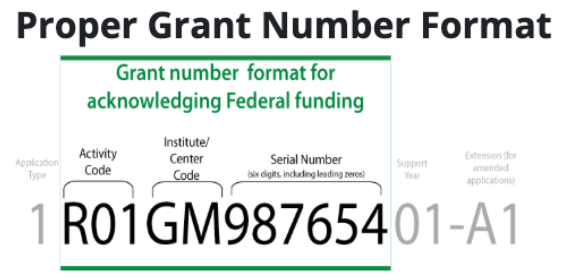
"Research reported in this [publication/press release] was supported by [name of the Institute(s), Center, or other NIH offices] of the National Institutes of Health under award number [specific NIH grant number(s) in this format: R01GM987654]." (If you have more than one grant, only cite the grant(s) that supported the research described in the article or presentation.)”
Disclaimer
“The content is solely the responsibility of the authors and does not necessarily represent the official views of the National Institutes of Health.”
The NIH Grants Policy Statement specifies how to properly acknowledge federal funding in the following projects or programs funded in whole or part by NIH:
- Research publications
- Press releases and other public statements
- Other publications or documents about research that is funded by NIH
- Requests for proposals and bid invitations
- Other documents describing projects or programs funded in whole or in part with Federal money
Acknowledge NIH awards on publications and other statements when the activities that contributed to that publication:
- Directly arise from the award, AND
- Are within the scope of the award being acknowledged
Ask the following questions:
- Did the personnel activity supported by the award contribute to the publication?
- Did the award support conduct of experiments or the analysis of data that contributed to the publication?
- Is there a clear and apparent link between the work described in the publication with the aims and objectives of the grant?
If the answer is yes to any of these, cite the appropriate NIH support.
NIH encourages encourages grantees who have used or generated HeLa cell whole genome sequence data to acknowledge Henrietta Lacks and her family.
See the NIH site for more information
If you are unsure reach out to Grants and Contracts at gcahelp@utah.edu
When an author accepted manuscript (AAM) is submitted to NIH there is an agreement to the Government Use License at 2 CFR 200.315, or its successor regulation. This agreement explicitly grants NIH the right to make that AAM available through PubMed Central.
By accepting NIH funding the recipient grants NIH“Royalty-free, nonexclusive, and irrevocable right to reproduce, publish, or otherwise use the work for federal purposes and to authorize others to do so”
A Rights statement is recommended in manuscripts, so journals are informed of NIH funding and this Government Use License agreement.
Per this Government Use License agreement authors not expected to provide rights to Final Published Article (FPA), however a FPA is acceptable to submit to PMC for compliance.
Government Use License Agreement
“I hereby grant to NIH, a royalty-free, nonexclusive, and irrevocable right to reproduce, publish, or otherwise use this work for Federal purposes and to authorize others to do so. This grant of rights includes the right to make the final, peer-reviewed manuscript publicly available in PubMed Central upon the Official Date of Publication.”
When it comes to proving compliance with the policy the PMCID is your proof of compliance, ensure the PMCID is added to your citation once received.
NOTICE: having a PMCID associated with your citation does not automatically guarantee compliance. The policy requires immediate deposit meaning the PMCID “available by” date should be around the same time as the “published in final edited form” date.
Example of a Non-Compliant Article
This article in the screenshot below has a PMCID but is still not compliant because it was not made available in PMC until several months after its official date of publication.

Example of a Compliant Article
This article is compliant because it has a PMCID and that PMCID was made available around the same time as the official date of publication.

When you start the NIHMS submission process you will receive an NIHMSID. You may use this NIHMSID in lieu of PMCID as proof of compliance for up to 3 months. It can take time for NIH to review your manuscript submission, but if you do not receive a PMCID within 3 months of your submission contact NIH directly.
Please keep in mind that a PubMed ID (PMID) is not the same as a PubMed Central ID (PMCID). PubMed and PubMed Central are two different websites with different functions.
- PubMed (PM): database of citations and abstracts, excludes full-text articles
- PubMed Central (PMC): electronic archive of freely available full-text journal articles
Ensure you have compliant citations by using My Bibliography to check and update citation compliance.
See My Bibliography page for additional information
Ensure you reference all applicable NIH awards in your citation, this includes any awards from NIH funded University departmental resources. For example, if you used CTSI (NIH funded) resources, then cite the specific CTSI award.
See NIH Overview page and Cost & Fees page for additional information on when and how to reference awards.
NIH does not specify which copyright license you need to select. There is no specific copyright that needs to be used in order to comply with the public access policy.
- PubMed (PM): database of citations and abstracts, excludes full-text articles
- PubMed Central (PMC): electronic archive of freely available full-text journal articles
- NIH Manuscript Submission System (NIHMS): system for submitting manuscripts to PMC
- Recommended to use ”login.gov” login and link to eRA commons
- My Bibliography: reference tool to save citations from PM/PMC or to manually upload citations
- Recommended to use ”login.gov” login and link to eRA commons
- Final Published Article (FPA): journal's authoritative copy, including journal or publisher copyediting and stylistic edits, and formatting changes, even prior to the compilation of a volume or issue or the assignment of associated metadata.
- Author Accepted Manuscript (AAM): author’s final version that has been accepted for journal publication and includes all revisions resulting from the peer review process, including all associated tables, graphics, and supplemental material.
- Official Date of Publication: date on which the Final Published Article is first made available in final, edited form, whether in print or electronic (i.e., online) format.
More about NIH Public Access
Not seeing what you're looking for?
We’re here to help—visit our FAQs, send us your questions or feedback, or contact your departmental compliance specialist for additional support.